It's Tuesday at 9:30 and eight people are on a status call trying to work out whether the client's revised brief reached the designer.
It did, on Friday, in a Slack thread between two people.
Nobody else saw it. The designer waited, the project manager followed up, and now there is a meeting whose main job is to work out what happened.
This is often how status meetings start multiplying. Something gets missed, so another check-in gets added.
The real problem usually happened earlier.
How a handover goes missingTake a fairly standard 40-person agency.
Sales closes a project and the scope lives in the proposal. The account lead emails a summary to the delivery lead, who breaks it into tasks in the project tool.
In week two, the designer finishes the first round and posts "done, over to you" in Slack.
The developer is busy with another client and doesn't see it. The project board still says "In progress". It stays that way for nine days.
The problem is that each handover happened somewhere different, so when the project manager needs to know where things stand, they have to ask.
Do that across enough projects and a status meeting starts to look like the easiest answer.
Why another meeting doesn't fix itWhen projects start slipping, leaders often decide the team needs to communicate more.
So another meeting goes in the diary.
For half an hour, everyone catches up. Then the call ends and the same thing starts again. A client changes something by email. Someone finishes a task and forgets to update the board. An approval gets buried in Slack.
By the next meeting, people are piecing the story together again.
Microsoft's 2025 research on the infinite work day found employees using its tools are interrupted every two minutes during core hours by a meeting, email or chat. It also found that 57% of meetings are ad hoc calls with no calendar invite.
Some of those calls exist because someone needs an update that should already be visible.
The deadline is where the problem shows up. The missed handover usually happened earlier.
We had the same problem with SlackWe fell into this ourselves.
For a long time, our project updates lived in Slack. It was convenient. You could check your phone and quickly see what was happening across different projects.
The problem was that important updates got buried.
So we changed the rule.
Project updates now go into monday.com first, and an automation sends them to Slack.
People can still read the update in Slack, but the project record stays with the project. Milo, our AI assistant, can also pick up overdue tasks, slipped dates and missing updates because the information is somewhere it can read.
We have seen the more expensive version of this with clients too.
One client managed a timeline in Miro, copied it into Excel and then created the actual tasks in Trello. Every change meant updating three tools by hand.
On a separate product order, someone forgot to update a spreadsheet and the business lost hundreds of thousands of pounds.
Growth makes these gaps harder to get away with. We went from 8 to 27 people in six to eight months, and processes that worked when everyone knew what was happening stopped working. New people joined without all the history in their heads, and clients sometimes noticed the gaps before we did.
Find the handovers your project tool is missingYou can test this on one project that slipped.
Start at the signed proposal and work through to the final invoice. Each time work moved from one person to another, check where that handover was recorded.
If it only exists in Slack, email or someone's memory, you have found a weak point. Then look at the handovers that go wrong most often.
In monday. com, that could be as simple as changing a task to "Ready for dev", assigning the developer automatically and notifying them.
For a bigger handover, such as sales to delivery, decide what has to be there before the work moves. That might be the signed statement of work, budgeted hours, client contact and the main things agreed during scoping.
The useful part is making the handover visible in the same place the project is being managed.
You can do the same with updates. Write the update against the project, then automate it into Slack or Teams.
People keep using the tools they already use. The project still has a reliable record.
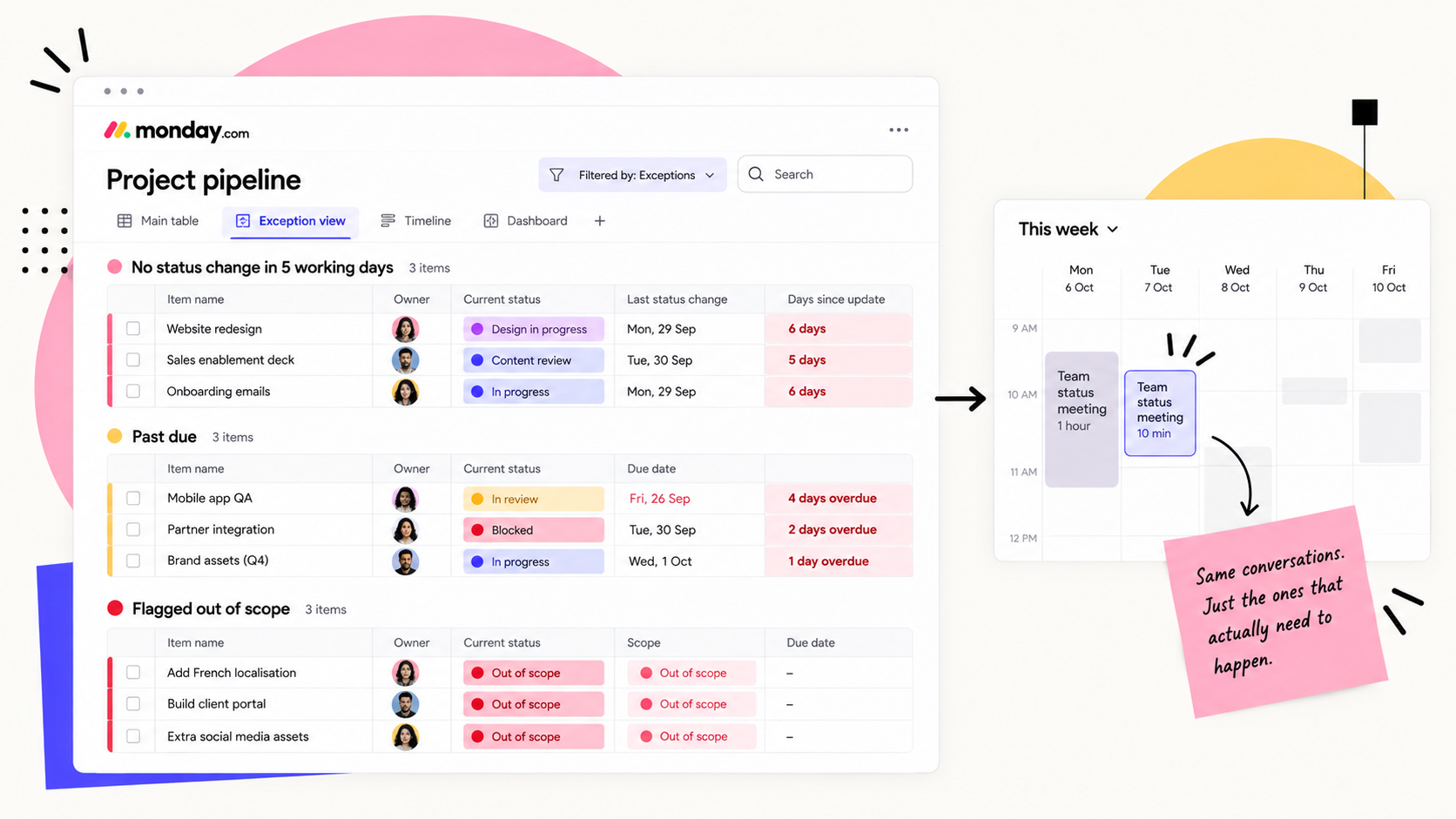
Then change the status meetingOnce the board is being updated properly, the meeting can focus on the things that need attention.
Look at overdue work, items waiting on someone else and anything that may be outside scope.
Keep the meetings that are usefulSome things still need a conversation. Priorities change. Two projects need the same person. A client relationship is going badly. A judgement call needs to be made.
If your status meeting is mostly people asking "where is this up to?", start with the handovers.
Pick one project that slipped and find every place where work changed hands.
That is usually a better place to fix the problem than adding another meeting.