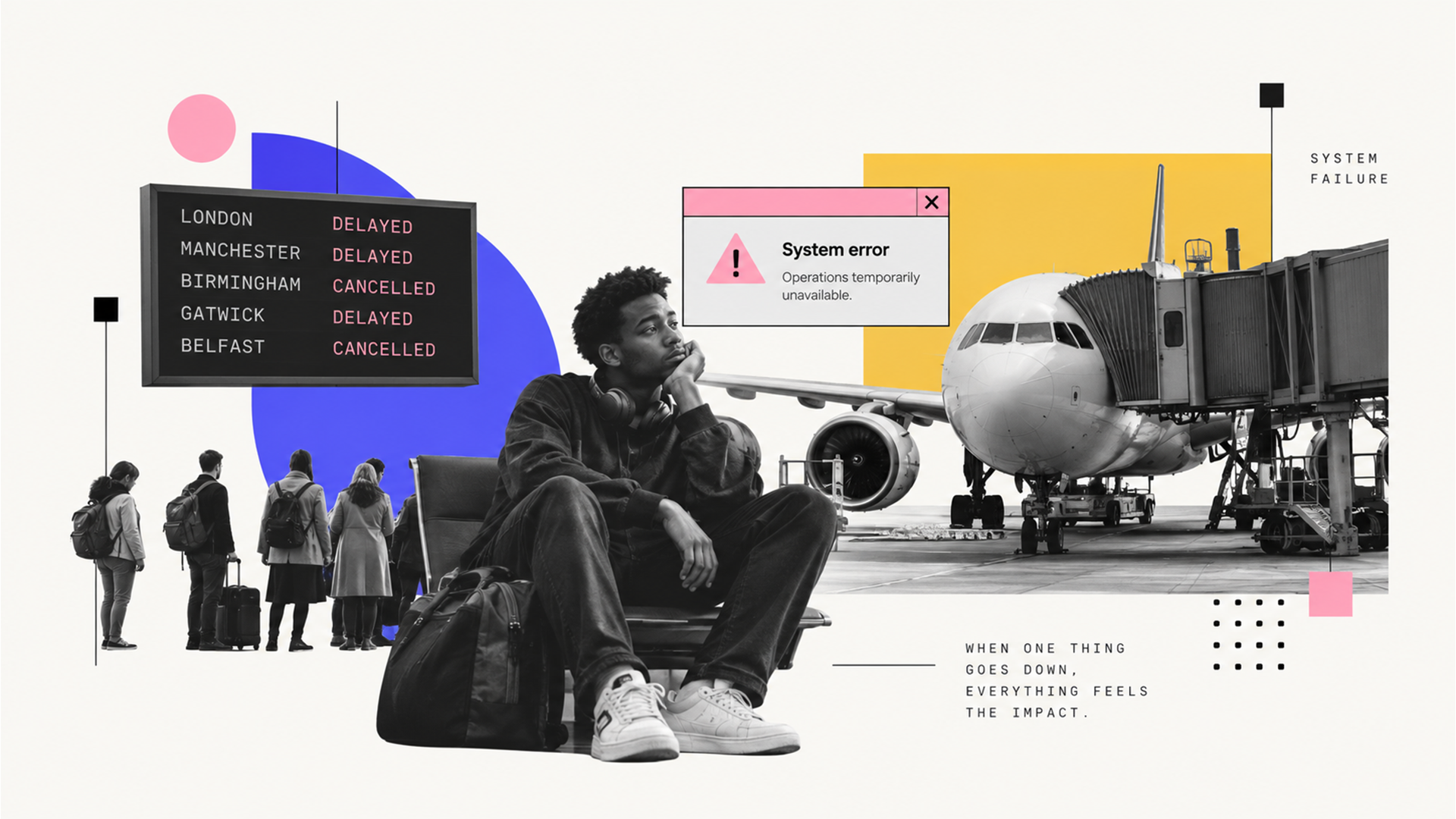
Martin Brundle spent nine hours going nowhere.
You would think he was maybe stuck on the M25 on a Friday afternoon, but you would be wrong. He was stuck on a British Airways plane, parked at a remote stand at Heathrow, while a mother with a baby, a passenger with a medical condition and several hundred increasingly furious strangers waited for someone, anyone, to bring stairs.
The most shocking thing is that passengers didn't even have access to food. And more horrifying is that the toilets became blocked. At this point you would think that they would disembark and take a bus back to the terminal. But yet again, you would be wrong.
"Pathetic and dangerous," he wrote afterwards, in a post that racked up more than a million views, as GPFans reported.
I, for one, would have loved a nine-hour conversation with the legendary Martin Brundle, but let's cut the jokes for a minute. What happened here is a pretty shocking example of something going terribly wrong.
And Brundle wasn't exaggerating. He wasn't even alone.
On 8 September, a single flight-data glitch at NATS's Swanwick control centre grounded, delayed or cancelled close to 1,000 flights across the UK, from Heathrow and Gatwick to Manchester, Birmingham and Belfast. Ryanair alone counted 65,000 stranded passengers, Tech Times reported.
What I find more worrying is that this wasn't the first time. It wasn't even the third.
NATS had a near-identical meltdown in August 2023, when two waypoints sharing a name broke both the primary and backup system because they ran the same code. The result was roughly £100 million in costs and 700,000 stranded passengers, according to Tech Times.
Another failure followed in July 2025, cancelling more than 150 flights, Al Jazeera reported at the time.
Then this September's collapse happened less than three months after the UK's aviation regulator formally certified that all 34 recommendations from the official post-2023 reform review had been completed.
So everything had apparently been fixed in June. And by September, it had happened again.
Ryanair's chief operating officer publicly demanded that the NATS chief executive resign, noting that "we were told lessons would be learned" last time too, Tech Times reported.
And it isn't just the air traffic control system.
The ground infrastructure simply cannot hold when you consider that Heathrow's entire operation was shut for 18 hours in March 2025 after a substation fire. The fire was later traced to a fault that National Grid's own engineers had flagged seven years earlier and simply never fixed.
Because fixing things costs money, and not fixing things is free.
Until it very expensively isn't.
This is where the story starts to feel less like an aviation problem and more like a business problem.
Most businesses have their own version of this. It might be the one spreadsheet Sandra maintains, the approval that only goes through if Dave is at his desk, or a process that relies on someone remembering to move something from one system to another.
Most of the time, nobody notices. The process works, people get used to it and it becomes "the way we do things". Then someone is off sick, a system goes down or a handoff gets missed, and suddenly nobody is quite sure what happens next.
That's the bit that interests me. How many businesses have processes that work perfectly well, right up until something goes wrong?
Heathrow didn't lack contingency because contingency is particularly difficult. It lacked contingency because nobody had made it someone's job to work out what happened when the normal process stopped working. By the time everyone realised there was a problem, the plane was already sitting on the tarmac with a baby on board.
That is essentially why we built mutherboard.
We spend a lot of our time looking at those points of failure and asking what happens when the person, system or step that everyone relies on isn't available.
The aim isn't to make a process look good on a diagram or produce another piece of documentation that gets signed off and forgotten about. It's to build workflows that can actually cope when something goes wrong.
That might mean rerouting a process, escalating something to another person, or making sure there is another way of getting the work done when the usual system isn't available.
Because in a business, just as at an airport, the real test of a process isn't how well it works when everything is going according to plan. It's what happens when it doesn't.
If your operations still depend on one unbroken chain of manual steps, you might have a process that works today. But what happens when one of those steps disappears?
Brundle got his nine hours back the hard way.
Most businesses lose theirs one silent, untweeted outage at a time. The difference is that nobody is live-tweeting your quarterly numbers.
Yet.
mutherboard works with businesses to find exactly where their workflows break down, and rebuild them before the whole operation ends up stranded on the tarmac.